
descent
and a meditation on the community of words

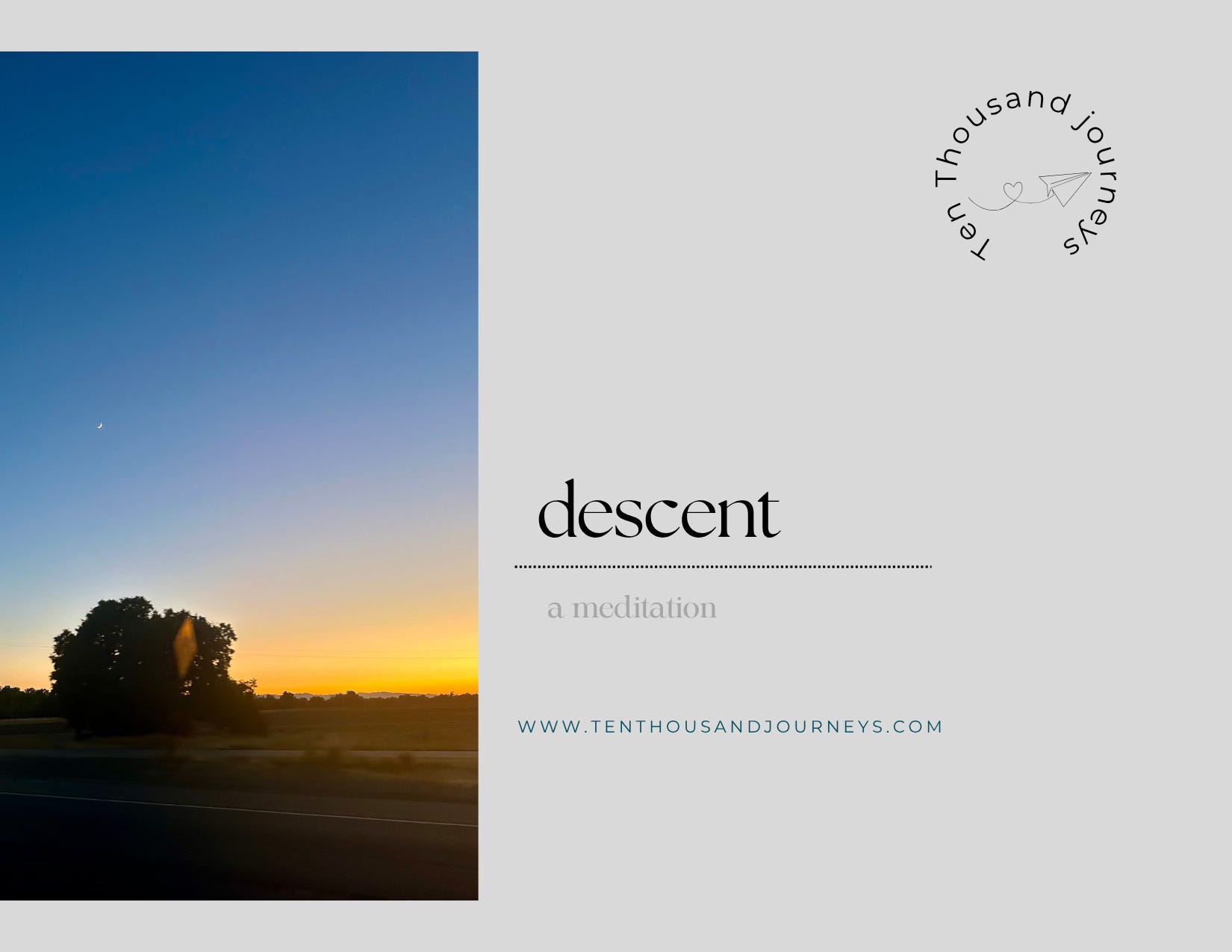
I usually write in the morning, within minutes of waking up and brewing myself a cup of hot tea. I have learned that’s the time words are more likely to be passing through, and I can listen and take down something of what they seem to be saying. The founder of archetypal psychology, James Hillman, said this wonderful (full of wonder) thing about words, reminding us they are autonomous beings.
"We need to recall the angel aspect of the word, recognizing words as independent carriers of soul between people. We need to recall that we do not just make words up or learn them in school, or ever have them fully under control. Words, like angels, are powers which have invisible power over us.
- James Hillman (1975) in Re-Visioning Psychology (Harper & Row)
(I often think this must at least be one of the reasons for the subtle differences between what a writer writes, and the meanings and stories we make of what we read.)
So, I usually write in the mornings, but today, I am writing in the evening. I have come home in an enchanted daze because as I drove home, I noticed that, low in the sky, close to the horizon, there was an old-fashioned train, a locomotive pulling many carriages, the entire apparatus of the train made up of dense white clouds. It chugged along, and there was even a cloud trail of billowing steam rising from the locomotive engine. A small flock of cloud-swallows flew in circles above the train. As if that wasn’t magical enough, I seem to have arrived home at the exact time the birds who live in the oak tree next to the house have returned, and the evening is alive with their movement and chatter. I remember the sounds of evenings in the apartment building I lived in as a young girl growing up in Mumbai - the excited, high-pitched voices of children competing with TV noises, the lower rumbling tones of the adults, the clink of steel vessels as dinner is cooked, the whistle of the pressure cooker periodically puncturing all the other noises, and the occasional bark of a dog. The intricate tapestry of these sounds overlay the near-constant low hum of traffic. That’s what the oak tree reminds me of, the apartment building of my childhood. It offers me a feeling of community, and of having come home even though that earlier home recedes further and further into the past until it feels like it was all a dream.
As part of the series on meditations on words, I have been trying to write about ‘pomegranate,’ but another word keeps getting in the way and that is ‘descent’. Perhaps that is inevitable because pomegranates bring up the myth of Persephone and her abduction by Hades into the underworld. The Persephone-Hades myth, like many metaphorical journeys, starts with a descent.
What is the sound of descent? What is its color or is it only an after-color? Is it the color of the sky in the aftermath of the setting sun? What time of day does descent bring up for you? What does it taste like? Does it have to be valorous? There is no single, right answer.
Perhaps we have to look at descent before we eat the pomegranate. And, right there in that line, we can see what might happen when we talk about any metaphorical descent. There is hope hidden in it, of, one day, finding treasure, of coming back with treasure. Just like pomegranate can point to descent, descent may point to an eventual arrival. Perhaps that is part of being human but it also speaks of the transformative potential within descent.
It made me think of how words don’t exist in isolation either. That language is a community of words coming together to make meaning. Pomegranate may point to fruits and the color red, and also to the heart because of its jeweled chambers. But it also points to the invisible myth standing behind, present even now in contemporary times, to mothers and daughters, descent, and inhabiting two worlds. Just like descent may inevitably point to the hope of arrival.
I’d love to hear what you think.
This was a deep, meaningful read. I really enjoyed it.
What a treat it is to read your writing again, Priya! This piece is so evocative. And it makes me wonder if you may have ever read Maureen Murdock's, The Heroine's Journey? I find it interesting how she frames the Hero's Journey as one of ascent, and the Heroine's Journey as one of descent within. As the fairer sex😁perhaps we have a tendency to dwell in our interiority more than the exteriority...? In any case, I enjoyed Murdock's exploration and investigation of the descent within. And perhaps the descent is simply more of a yin journey, and the ascent is more of a yang journey, and both men and women embark upon both...? thank you for inspiring these fun ponderings on this Monday morning as we're about to depart from Monument Valley which sits right on the border of Arizona and Utah, and I wish I could share a photo here as it's quite spectacular. I'll just have to write a post♥️🔥🙏